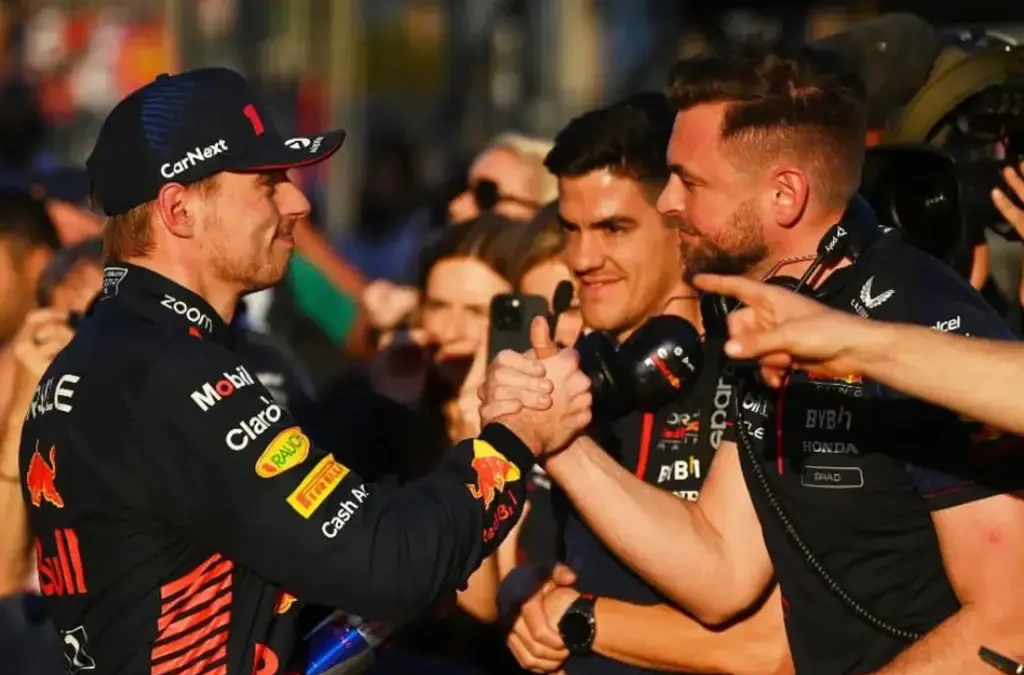


After another great win out in Montreal, Canada making it 4 in a row for us, we had a good week at home, recovering and training to get ready for our first home race of the year at the Red Bull Ring in Spielberg, Austria. A place I love not just for the country and the people but it was also my first ever F1 race.
The Red Bull Ring is a short track, with a length of 4.318 kilometres and a total of 10 turns (in theory less if it’s dry). The track has a maximum elevation change of 65 meters, with the highest point at the second corner and I can testify that it is the hardest track to run! By turn 2 your bowing having climbed that height, and then the knees take a toll coming back down towards the end….but the view from the top is awesome.
Charactaristics of The Red Bull Ring
The Red Bull Ring is characterised by high-speed corners, long straights, and heavy braking zones. It’s fast and technical and drivers get to do it for 71 laps. The track’s most challenging section is Turn 1, which requires drivers to brake hard from 330 kph to 70 kph in just 2.5 seconds. This corner is followed by a steep uphill climb, which puts a tremendous strain on the engine and tires. The track’s other notable corners include Turn 3, a high-speed right-hander, and Turn 9, a hairpin turn that leads to the final straight.
The Red Bull Ring is a physically demanding track for drivers, with high g-forces and heavy braking zones. According to research by Di Salvo et al. (2019), the track’s average g-force is 3.4g, with the highest g-force recorded at Turn 9, which is 4.7g. Turn 3 also has a g-force of 4.2 with a further three turns being above 3.5g. The elevation changes also put a significant axial compressive strain on the driver’s neck muscles.
The heavy braking zones require drivers to apply a force of up to 5g, which can be physically exhausting. Turn 1 bring the heaviest requiring a braking force of 5.5g, and g-force of 3.6g and Turn 3 closely following with a braking force of 4.5g and g-force of 4.2g.
These physical demands can cause drivers to experience high levels of physical stress. Kounalakis et al. (2020) found that the track’s high g-forces and heavy braking zones can led to increased heart rate, blood pressure, and oxygen consumption. Menz, Kröll and Würth (2015) found in simulations of the Red Bull Ring drivers heart rate reached 190 beats per minute, you can only imagine in the real life scenario this is higher. These physiological demands can cause drivers to experience fatigue, dehydration, and heat stress, which in turn can impact foucs, and decision making affecting their performance on the track.
We also have the joys of navigating a race weekend with the new sprint qualifying format which I still can decide whether I like or not. It certainly makes Saturday a strange and long day. We plan our nutrition across the weekend slightly different, and it is imperative drivers come into the weekend sharp straight from the go, but otherwise is business as usual and we go out to give it our all as always!
References:
- Di Salvo, V., Baron, R., Tschan, H., Calderon-Montero, F. J., Bachl, N., & Pigozzi, F. (2019). The physical and physiological demands during a single-seater car race. Journal of sports science & medicine, 18(4), 697.
- Kounalakis, S. N., Kyparos, A., Nikolaidis, P. T., & Rodio, A. (2020). Physiological demands of single-seater car racing: A review. Journal of Science and Medicine in Sport, 23(7), 652-658.
- Menz, M., Kröll, J., & Würth, S. (2015). Physical performance aspects of a Formula 1 racing driver. Journal of Human Kinetics, 49, 237-245.
SIGN UP To Elite Formula Physio & Training
At Elite Formula Physio & Training, individuals are presented with a unique opportunity to receive personalised and top-tier coaching in performance and physiotherapy, a privilege typically reserved for professional athletes. Led by Bradley Scanes, a Human Performance Consultant at Red Bull Racing & Red Bull Technology, the team brings a wealth of experience and expertise to their approach, ensuring the utmost care for their clients.
In addition to Bradley Scanes, the team includes Matt Murray-Downing, a Formula 2 Physiotherapist and Performance Coach, and Grace Covington, a Physiotherapist for the England Women’s Rugby Team. Both members contribute their specialized knowledge and experience in physiotherapy and performance coaching. Elite Formula Physio & Training is dedicated to delivering customized programs that cater to the unique needs and goals of each client. Whether individuals aim to enhance their athletic performance or recover from an injury, the team possesses the necessary expertise to guide them towards success.